Taking Player Notes Tips

Whenever you play poker, it is always important to try and be aware of your opponents' actions, and what their particular style of play may be. Especially so in the game of Texas Holdem, it is vital that you are able to play your opponent and not just your own cards.
Therefore you should always try and take into account how your opponent plays to help influence every decision you make to help you choose the most profitable action possible. A simple yet effective way of remembering an opponent’s style of play for key moments is taking notes on them from past experiences at the table.
Advantages of taking player notes.
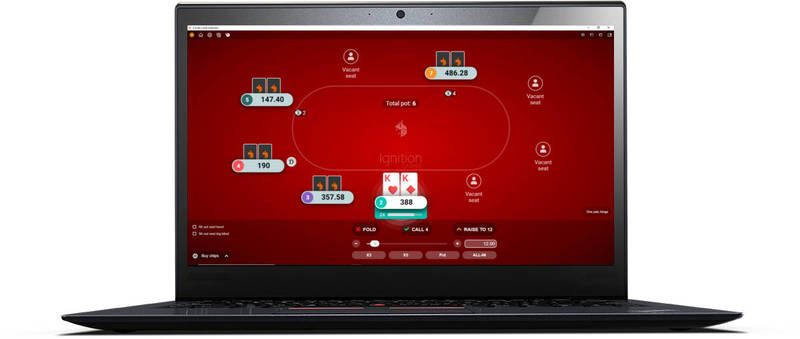
Most online poker rooms will offer you the feature of being able to assign notes to individual players at the table. Some rooms will even allow you to tag players with different symbols or colours to help identify them from other players at the table.
The Full-Tilt Poker room has a particularly good player notes feature, as it offers you the ability to tag a colour to your opponents as well as take notes. This particular feature is incredibly useful, and to be honest I don’t think I could see myself playing at any room that did not have the note-taking option available.
By taking notes on your opponents you can quickly find out information on players who you have played against before, but have since forgotten from the last time you were at the table with them. I do believe that it is important to try and keep your notes on your opponents as simple as possible, and to be frank, I don’t want to bring up the note box and have to decipher lines of code every time I want to find out some basic info on the other players at the table.
Keep your player notes simple and understandable. There's no need to write in a cryptic code.
So even though I want to be fully briefed on my opponents, I want to keep the notes simple and straightforward. But what exactly should you be taking notes of on your opponents?
Key poker player notes.
Style of play.
I feel a good place to start off is to try and determine what my opponent’s particular style of play is. I want to try and find out whether or not they are:
- Tight-Aggressive.
- Tight-Passive.
- Loose-Aggressive.
- or Loose-Passive.
This can be done by watching they way they play their hands. This is because this information can be very important for where you might be forced into a difficult call or fold situation.
For example, if I have a decent hand and I am facing a large bet from my opponent, I am more likely to call if I know my opponent is Loose-Aggressive rather than Tight-Aggressive. Therefore I will usually shorten these tags down to TA, TP, LA and LP and stick them at the top of the note box for quick reference when I want some info on my opponents.
Other key information.
After taking note of a particular player’s style of play, I want to make a few little key notes on other aspects of their game. Below is a list of a few of the most important things I am looking for when watching my opponents play:
- Do they pay too much for draws?
- Do they bet draws?
- Do they make continuation bets?
- Do they make float plays?
- Do they over-value top pair?
- Are they a calling station?
These in my opinion are the most important and profitable factors of my opponent’s game that I want to be aware of. There are going to be numerous tidbits that I can pick up on and note down, but the 5 points above are the ones that are going to help me the most. This is because knowing these points will help me in a multitude of common situations in the game.
For example, if I know my opponent over-values top pair, I am going to bet like crazy when I am holding a monster rather than try and slow play and sucker them in. Furthermore, If I know my opponent pays too much with drawing hands, I am going to bet big when they are drawing to make them pay dearly and help them make bigger and bigger mistakes by calling.
Player notes example.
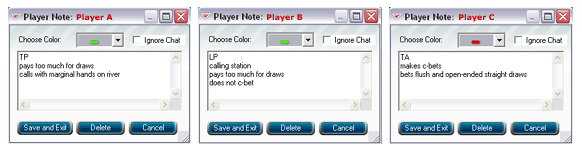
As you can see, the notes are simple and effective, as they allow me to quickly see what my opponent is like without having to try and figure out different short-handed codes I have for each player. I don’t often use the coloured tags for my opponents if they are available, as I feel that the majority of key info will be kept within my notes. However, I will sometimes use 2 colours like green and red to help signify a very weak player and a very strong player.
Use the colour tags to your advantage, but don't feel obliged to have to use all the different colours available. Keep it simple.
Taking player notes evaluation.
The style of note taking as described above is the one that works best for me, so you may find that an alternative method may work better for you. However, I like to think that the above method is a good foundation for note taking and should help you take down key info on your opponents if you are new to using the note-taking feature.
But you should remember that notes should build up from a few hours of play with your opponents, as it is not easy to build up an accurate picture from a mere few minutes or hands at the table. However, when you do take player notes, just stick with something simple and easy to understand.
If you have a certain note-taking method that you find very useful and would like to share with other readers, feel free to send me an email at greg[at]thepokerbank[dot]com and I will post it up for other visitors to see.
Go back to the awesome Texas Hold'em Strategy.
Comments